

The Flomec Positive Displacement Range: Matching the Right Meter to Fuel, Oil and Chemical Applications
When accuracy matters on fuel, oil and chemical lines, positive displacement meters are often the first choice. They measure volume directly, they are not bothered by bends and valves in the pipework, and they get more accurate, not less, as liquids get thicker. For batching, dispensing, dosing and transfer, few technologies match them.
The Flomec positive displacement range covers everything from tiny dosing flows measured in litres per hour through to bulk transfer at thousands of litres per minute. This guide explains how the meters work, walks through each part of the range, and shows how to match the right model to your fluid, flow rate and site.
How Positive Displacement Measurement Works
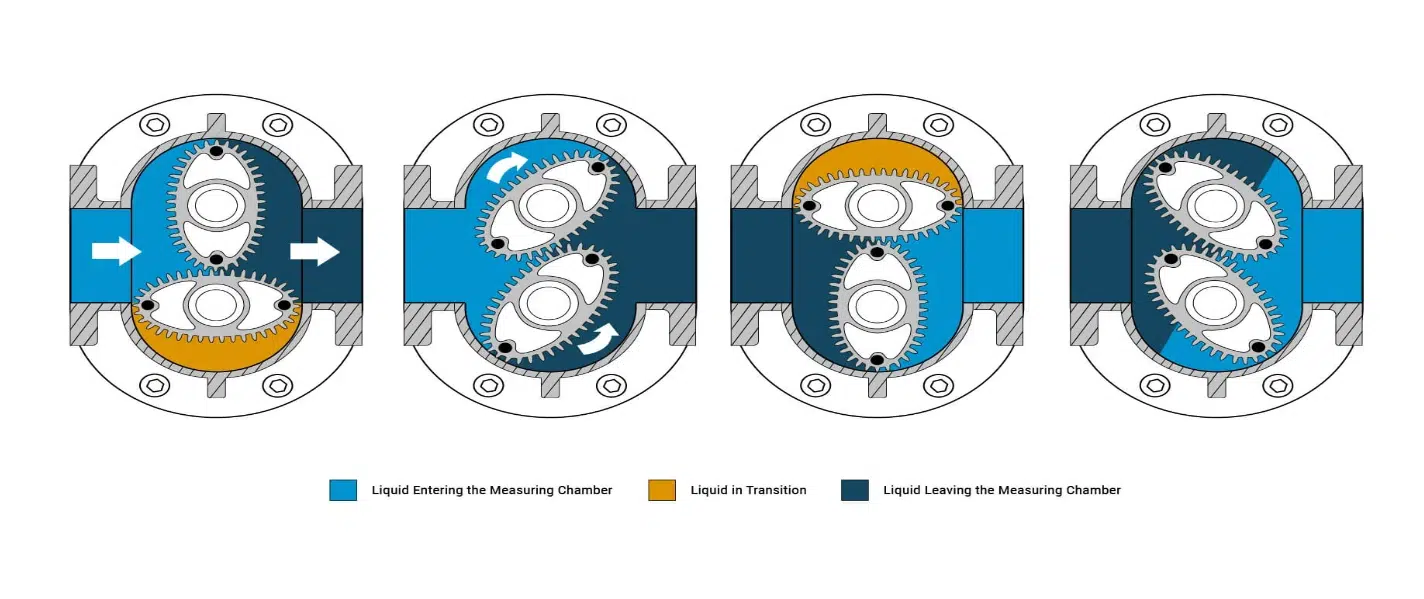
A positive displacement flow meter measures flow by trapping liquid in chambers of a known volume and counting how often those chambers fill and empty. Every rotation moves the same measured amount of liquid, so the meter is effectively counting fixed-size buckets of fluid. For a closer look at why this approach suits thicker liquids, see our guide to positive displacement flow meters for viscous liquids.
The oval gear design
The Flomec OM and EGM series use the oval gear principle, one of the simplest and most reliable positive displacement designs:
- Two oval gears mesh together inside a precisely machined chamber.
- Pressure from the flowing liquid turns the gears.
- As they turn, each gear traps a pocket of liquid against the chamber wall and carries it from the inlet to the outlet.
- Magnets in the gears trigger a sensor or drive a mechanical register, counting each rotation.
- Because every rotation moves a fixed volume, counting rotations gives an accurate total and flow rate.
With only two moving parts, oval gear meters are compact, robust and straightforward to service.
Why positive displacement suits oils, fuels and chemicals
- Direct volumetric measurement. The meter measures volume itself, not velocity, so it is not thrown off by changes in the flow profile.
- Accuracy improves with viscosity. Thicker liquids reduce the tiny amount of liquid that slips past the gears, so accuracy and repeatability are excellent on oils, lubricants and resins.
- No straight pipe needed. The meter can be installed right next to pumps, valves and bends, which makes it ideal for skids, tankers and cramped plant rooms.
- Works with non-conductive liquids. Unlike electromagnetic meters, positive displacement meters measure fuels, oils and solvents, which have little or no conductivity.
- Well suited to batching. High repeatability means the same quantity is delivered every time, which is essential for batching and dispensing.
If you are weighing up positive displacement against other options, our comparison of positive displacement vs turbine flow meters explains when each technology makes sense.

The Flomec Positive Displacement Range at a Glance
| Meter | Flow range | Best suited to |
|---|---|---|
| OM Small Capacity (1/8″ to 3/8″) | 0.5 L/hr to 550 L/hr | Chemical dosing, additive injection, very low flows |
| OM Medium Capacity (1/2″ to 2″) | 1 L/min to 450 L/min | Fuel, oil and chemical transfer, general industrial use |
| OM Large Capacity (3″ to 4″) | 35 L/min to 2,500 L/min | Bulk fuel and oil transfer, tanker loading and unloading |
| OM Chemical Meter (1″) | 10 L/min to 150 L/min | Batching, dosing and packaging of aggressive chemicals |
| EGM Series | 1 L/hr to 80 L/min | Pulse output for remote displays, batch controllers and control systems |
| QM40 Mechanical Fuel Meter | Up to 150 L/min | Fleet, heavy equipment and agricultural fuel dispensing |
Browse the full range, including display and batching options, in our positive displacement flow meters category.
Matching the Meter to Your Application
Diesel and fuel
Fuel measurement ranges from refuelling a single machine to bulk transfer from storage tanks. For bulk and tanker transfer, the Flomec OM Large Capacity flow meters handle diesel, fuels and kerosene at up to 2,500 L/min, with optional hazardous area approval for installations where flammable vapours may be present. For fleet refuelling and dispensing, the Flomec QM40 mechanical fuel meter uses an oval gear with a frictionless magnetic drive, is factory set to ±1% with ±0.5% achievable when calibrated in the field, and needs no power at all. That makes it a practical choice for fuel trailers, farm tanks and site bowsers.
Our article on fuel flow meters covers fuel measurement in more detail, and you can browse all fuel flow meters in our range.
Lubricants, hydraulic oils and edible oils
Oils are where positive displacement meters really shine. As viscosity increases, accuracy and repeatability improve. The Flomec OM Medium Capacity flow meters cover the most common line sizes, from 15 mm to 50 mm, and suit lubricating oils, hydraulic fluids, edible oils, resins and solvents. Aluminium bodies suit most oils and fuels, while stainless steel is available where the liquid calls for greater chemical resistance.
Chemicals and dosing
Aggressive chemicals need materials that will not corrode. The Flomec OM Chemical flow meter is designed for batching, dosing and packaging corrosive and water-based chemicals, and provides a lower-cost alternative to a full 316 stainless steel meter. Output options include 4–20 mA, scaled pulse, alarms and batch control. For very small dosing flows, such as additive injection, the Flomec OM Small Capacity meter with RT14 measures flows as low as 0.5 L/hr, with optional PPS rotors for chemical compatibility.
Always confirm chemical compatibility for both the meter body and the rotors before ordering. Concentration and temperature both affect which materials are suitable.
Viscosity, Temperature and Flow Range Considerations
Getting the size right is the most important decision when specifying a positive displacement meter. A few principles help:
- Size for your real flow, not the pipe. Choose a meter whose range comfortably covers your normal operating flow. Running a meter at the very top of its range continuously increases wear.
- Allow for viscosity. Thicker liquids create more pressure drop across the meter. If a liquid is very viscous, a larger meter may be needed to keep pressure drop within what your pump can deliver.
- Consider temperature. Viscosity changes with temperature, so an oil that flows freely in summer can be much thicker on a cold winter morning. Size for the worst case.
- Check pressure ratings. Confirm the meter’s maximum pressure is above your system’s highest operating pressure, including any pressure spikes from pumps starting or valves closing.
- Filter upstream. Oval gear meters have close internal tolerances, so a strainer before the meter protects the gears from particles.
- Remove air. Positive displacement meters count whatever passes through, including air. On fuel transfer lines where tanks can run low, an air eliminator prevents air being measured as fuel.
Display, Output and Mounting Options
How you need to read or use the flow data shapes the rest of the specification.

Local display
Many OM meters are available with an integral LCD display showing flow rate and total, or with a mechanical display that needs no power at all. Mechanical registers are popular on fuel dispensing and remote sites where batteries and power are inconvenient.
Remote displays and rate totalisers
Where the meter is hard to see, a remote display can be mounted in a more convenient location. The Flomec RT40 rate totaliser is battery powered, shows flow rate, a resettable total and a cumulative total, and can provide a scaled pulse or 4–20 mA output when externally powered.
Pulse outputs for control systems
The Flomec EGM Series provides a pulse output that connects directly to most remote electronics, PLCs and data loggers. OM meters also offer quadrature pulse outputs, which allow bidirectional measurement and help reject false counts from vibration.
Batch control
For filling, dosing and dispensing a set quantity, pairing an OM meter with a batch controller automates the process. The Flomec OM meter with EB11 batch controller lets operators enter a quantity and have the system stop automatically once it has been delivered, reducing overfills and manual errors.

Mounting
Because positive displacement meters do not need straight pipe runs, they can be mounted close to pumps, hose reels and valves. Install the meter so the gear shafts are horizontal where the manufacturer recommends it, keep the meter full of liquid, and make sure it can be reached for servicing and calibration.
Keeping Your Meter Accurate Over Time
Positive displacement meters are simple and durable, but like any instrument with moving parts, a little routine care keeps them accurate for years.
- Clean the strainer regularly. A blocked strainer starves the meter and increases pressure drop. How often depends on how clean the liquid is, so check it frequently at first and set a schedule from there.
- Check accuracy against a known volume. Dispensing into a calibrated container or prover and comparing the result with the meter reading is the simplest way to confirm the meter is still accurate.
- Recalibrate when the liquid changes. Because viscosity affects the small amount of slippage past the gears, switching to a noticeably thinner or thicker liquid can shift the reading. Many electronic registers allow the calibration factor to be adjusted in the field.
- Watch for changes in behaviour. A meter that becomes noisy, sticks at low flow or shows an unusual pressure drop may have worn gears or debris in the chamber.
- Protect it from dry running and surges. Running a meter on air or subjecting it to sudden pressure spikes can damage the gears. Keeping the meter full of liquid and starting pumps gradually helps it last longer.
With these simple habits, a correctly sized oval gear meter will give consistent, repeatable readings for many years.
A Quick Selection Checklist
- What liquid are you measuring, and what is its viscosity at the lowest expected temperature?
- What are your minimum, normal and maximum flow rates?
- What line size and connection type do you need?
- What are the maximum operating pressure and temperature?
- Is the area hazardous, requiring approved equipment?
- Do you need a local display, a remote display, a pulse or 4–20 mA output, or batch control?
- Is power available at the meter location?
Get the Right Meter for Your Application
You can browse the complete Flomec range online, or talk to our team about your fluid, flow rate and site conditions.
BES Flowmeters has been supplying flow meters and batching systems to Australian industry since 1986.
Not sure which meter suits your application? Call BES Flowmeters on (03) 5956 8685 or email sales@besflowmeters.com.au and our team will help you match the right meter to your pipe, fluid and budget.
Frequently Asked Questions
What is a positive displacement flow meter?
A positive displacement flow meter measures flow by trapping the liquid in chambers of a fixed, known volume and counting how many times those chambers fill and empty. Because it measures volume directly, it gives high accuracy and repeatability, particularly with oils, fuels and other viscous liquids.
How does an oval gear flow meter work?
An oval gear meter has two meshing oval-shaped gears inside a measuring chamber. The flowing liquid turns the gears, and each rotation moves a fixed volume of liquid from the inlet to the outlet. Magnets or sensors count the rotations, and the meter converts that count into flow rate and total volume.
Are oval gear meters suitable for thick liquids?
Yes. Oval gear meters generally perform very well with viscous liquids such as oils, lubricants and resins, because thicker liquids reduce the small amount of leakage past the gears. Higher viscosity also increases pressure drop, so the meter should be sized for the thickest liquid it will measure.
Do positive displacement meters need straight pipe runs?
No. Unlike turbine, electromagnetic and ultrasonic meters, positive displacement meters such as the Flomec OM series do not depend on the flow profile, so they do not need straight pipe before or after the meter. This makes them easy to fit into skids, vehicles and tight spaces.
Do I need a filter before a positive displacement meter?
Yes. Positive displacement meters have close internal tolerances and are designed for clean liquids. A strainer or filter upstream protects the gears from particles that could jam or wear them, and is recommended for almost every installation.